
Master of Social Sciences in the field of Applied Psychology
The NEW Master of Social Sciences in the field of Applied Psychology [MSocSc(APsy)] programme at the University of Hong Kong is designed to equip students with foundational knowledge of professional psychological theories and practice. The programme is underpinned by a robust academic rationale that draws upon the distinctive expertise and strengths of the Department of Psychology. The programme’s curriculum is carefully designed to integrate core psychological principles with applied skills, positioning it as a leading offering within the region. Moreover, the academic focus is informed by Hong Kong’s unique geographical and cultural context, as it is both part of Chinese Mainland and a nexus within the broader Asian regions. This strategic location affords unparalleled opportunities to apply psychological science, conduct empirical research, and develop theoretical frameworks that are both locally relevant and globally significant.
Rooted in a research-informed and academically rigorous curriculum, the programme integrates theoretical foundations, advanced research methods, and supervised applied learning experiences. Students are equipped to appraise research evidence on psychological assessments and interventions within Chinese societies and beyond.
There is a growing recognition of the value of translating psychological knowledge to address the escalating mental health challenges in our society. This programme responds directly to this need by preparing graduates to apply psychological principles to advance individual and population wellbeing. The curriculum bridges the gap between undergraduate theory and professional application, offering structured opportunities for experiential learning and reflective practice. While the programme does not confer professional licensure, it provides a valuable education for those seeking to enhance their careers in fields where psychological expertise is increasingly valued, including health, education, human resources, policy analysis, and community development. The programme also provides a strong foundation for further professional training in clinical and educational psychology, as well as for those who wish to continue their studies at the advanced research degrees at leading universities locally and overseas
Curriculum (2026/27 academic year)
The curriculum shall normatively be one academic year for full-time study. English is the medium of instruction. Candidates are required to complete a total of 60 credits including six compulsory courses, three elective courses and one capstone experience course as listed below:
Compulsory Courses
Candidates shall complete all of the following six courses:
PSYC7101. Introduction to concepts and approaches of psychological practice (6 credits)
PSYC7102. Evidence-based psychotherapeutic practice (6 credits)
PSYC7103. Psychological assessment (6 credits)
PSYC7104. Introduction to psychological research (6 credits)
PSYC7313. Introduction to health psychology and wellbeing (6 credits)
PSYC7314. Professional ethics and issues in psychology (6 credits)
Elective Courses
Candidates shall complete three of the following courses:
PSYC7106. Ageing and neurodegeneration (6 credits)
PSYC7107. Forensic psychology (6 credits)
PSYC7108. Special topics in applied psychology (6 credits)
PSYC7109. Experiential learning (6 credits)
PSYC7305. Developmental psychology (6 credits)
PSYC7318. Introduction to educational psychology (6 credits)
(Note: Not all the elective courses listed will necessarily be offered every year)
Capstone Experience Course
Candidates shall complete the following capstone experience course:
PSYC7120. Capstone project (6 credits)
Course Descriptions
Compulsory Courses
PSYC7101. Introduction to concepts and approaches of psychological practice (6 credits)
This course provides an overview of key concepts, frameworks, and professional roles in psychological practice. Students will be introduced to foundational ideas across therapeutic approaches, psychological assessment, and ethical standards. Emphasis is placed on understanding how theory connects to practice and the diverse contexts in which psychologists work. This course prepares students for deeper exploration of therapy, assessment, and ethics in subsequent modules within the programme.
Assessment: 100% coursework.
PSYC7102. Evidence-based psychotherapeutic practice (6 credits)
This course introduces students to the theoretical foundations and practical applications of psychological interventions. The course offers learning in psychological intervention skills that facilitate clients’ insight and underpin psychological change.
Assessment: 100% coursework.
PSYC7103. Psychological assessment (6 credits)
This course offers a foundational overview of psychological assessment, introducing students to key concepts, methods, and ethical considerations in the field. Emphasis is placed on understanding the purposes and principles of assessment across cognitive, emotional, and behavioural domains. Students will explore commonly used assessment tools and develop basic skills in test selection, administration, and interpretation. This course serves as a preparatory platform for more specialized training in psychoeducational, cognitive, and personality assessment.
Assessment: 100% coursework.
PSYC7104. Introduction to psychological research (6 credits)
This course adopts a practical approach to teaching the analytical aspects of research techniques in psychology. It is designed to provide students with the basic background in research design and data analysis. The logic of statistical inference and scientific explanation, the merits and limitations of quantitative approaches to the study of psychological phenomena, and research ethics will be discussed.
Assessment: 100% coursework.
PSYC7313. Introduction to health psychology and wellbeing (6 credits)
This course will provide a critical overview of both the psychological and social aspects of human health and wellbeing. Students will gain a foundation for understanding the role of psychology in the health context. Topics covered in this course include health behaviours, coping with health-related stress, social support and health, psychoimmunology, management of chronic illnesses, and patient-practitioner interaction etc.
Assessment: 100% coursework
PSYC7314. Professional ethics and issues in psychology (6 credits)
The purpose of the course is to provide general ethical guidance to cover typical situations encountered by professional psychologists. Models of ethical decision making will be introduced, discussed, and applied. In addition to the Code of Professional Conduct published by local professional bodies (e.g., the Hong Kong Psychological Society), a number of ethical codes, guidelines, and standards of practice will be reviewed.
Assessment: 100% coursework
Elective Courses
PSYC7106. Ageing and neurodegeneration (6 credits)
This course explores the biological, psychological, and clinical aspects of ageing and neurodegenerative disorders. Students will examine the mechanisms of normal and pathological ageing. The course integrates current research on cognitive decline, brain plasticity, and neurobiological changes associated with ageing. Through case studies and critical analysis of contemporary literature, students will gain a comprehensive understanding of the challenges and opportunities in promoting healthy ageing.
Assessment: 100% coursework.
PSYC7107. Forensic psychology (6 credits)
This course provides a comprehensive overview of the application of psychological principles for criminal behavioural analysis and risk assessment. Emphasis is placed on understanding the theoretical foundations, empirical research, and ethical considerations that inform forensic psychological work. The course is designed to equip students with foundational knowledge relevant to forensic settings and to foster critical thinking about the role of psychology in legal systems.
Assessment: 100% coursework.
PSYC7108. Special topics in applied psychology (6 credits)
This course explores current and emerging issues, trends, and specialized areas within the field of applied psychology. The course aims to deepen students’ understanding of complex challenges faced by psychologists and to foster critical thinking and adaptability in various professional contexts. Emphasis is placed on integrating theoretical knowledge with practical application to prepare students for specialized roles in the field. Individual topics may have special eligibility requirements.
Assessment: 100% coursework.
PSYC7109. Experiential learning (6 credits)
Students will have an experiential learning opportunity to apply psychology knowledge to understand real-life psychological issues and reflect upon this experience. Learning experiences include demonstrations and observations, roleplay, and case discussion. Students are expected to meet with the teacher(s) regularly, reflect upon specific psychological knowledge applied and how they affect various practices and people’s lives in society, and write a reflection paper to conclude the learning impact.
Assessment: 100% coursework
PSYC7305. Developmental psychology (6 credits)
This course covers current issues in developmental psychology and their applied implications. Students will actively solve problems and conduct small-scale projects related to selected topics in human development. There will be an emphasis on understanding basic concepts and theories of human development, research methodology and issues in developmental change, as well as biological, environmental and cognitive influences on development.
Assessment: 100% coursework.
PSYC7318. Introduction to educational psychology (6 credits)
This course focuses on how psychological theories are applied to learning, teaching, and the facilitation of human growth. The topics include major developmental theories and their application to learning and instruction; learning theories from both behavioural and cognitive traditions; effective teaching methods and practices; learners’ individual and group differences; achievement motivation; and assessment. Students will be involved in learning activities that require self-reflection and integration of daily life experiences.
Assessment: 100% coursework.
Capstone Experience Course
PSYC7120. Capstone project (6 credits)
This course comprises an independent research study in an area of applied psychological science. Students will engage in supervised psychological research. They are required to write a review or report on a research project (e.g., a meta-analytic review or a small-scale empirical project). The write-up should be about 4,000 to 5,000 words in length (excluding tables, figures, bibliographies, and appendices).
Assessment: 100% coursework.
1) To be eligible for admission to the programme, a candidate
- shall comply with the General Regulations and the Regulations for Taught Postgraduate Curricula;
- i) shall hold a Bachelor’s degree with a major in Psychology, or a recognized equivalent qualification of this University; or
ii) another qualification of equivalent standard from this University or from another University or comparable institution accepted for this purpose; - comply with the regulations for the degree of Master of Social Sciences.
2) The University’s English language requirements are as follows:
For a candidate who is seeking admission on the basis of a qualification from a university or comparable institution outside Hong Kong of which the language of teaching and/or examination is not English, shall satisfy the University English language requirement applicable to higher degrees as prescribed under General Regulation G2(b). For the acceptance range of performance for respective examinations and the validity period of the results, please refer to the Taught Postgraduate Admissions website for more details.
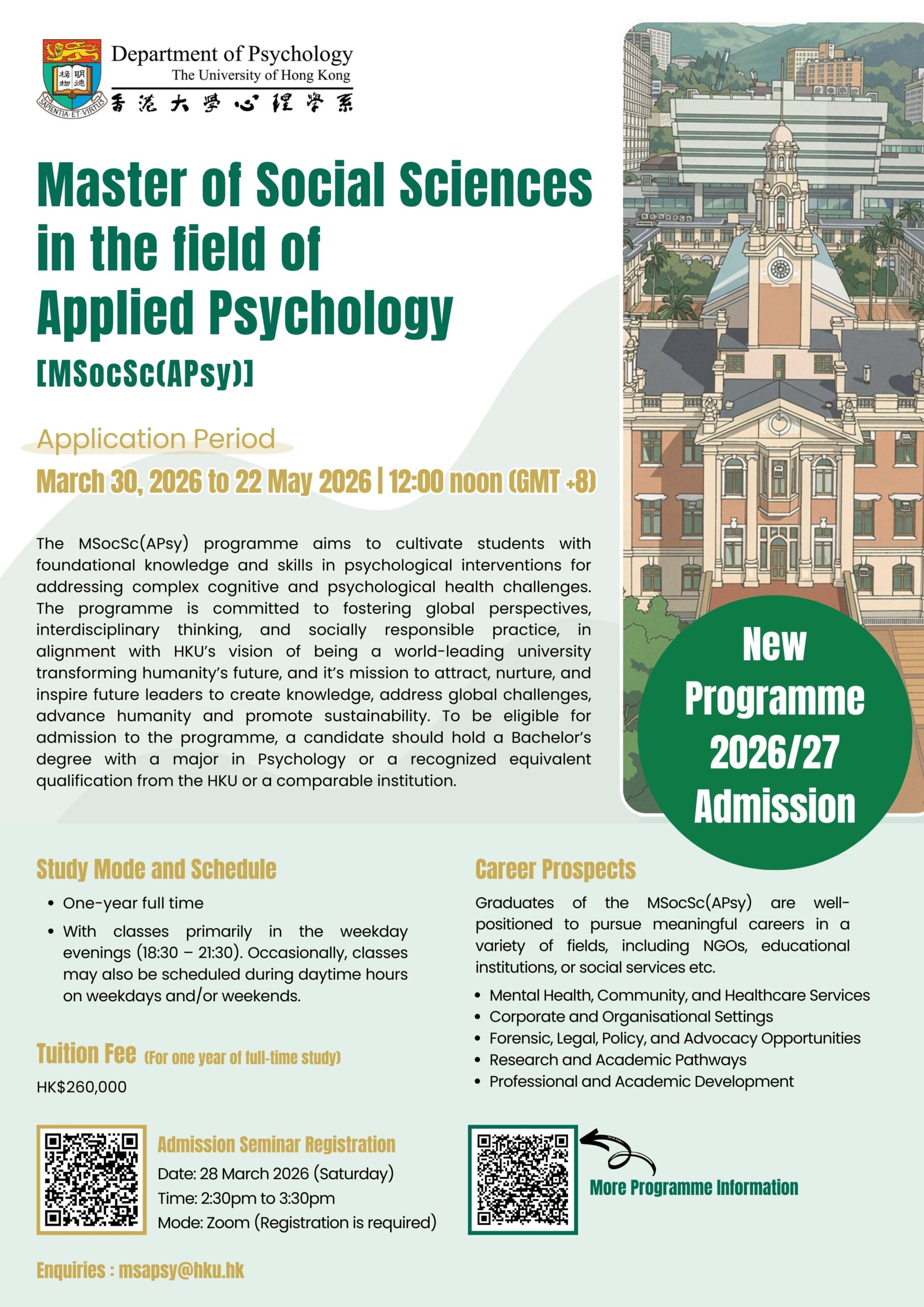
- One-year full time
- With classes primarily in the weekday evenings (18:30 – 21:30). Occasionally, classes may also be scheduled during daytime hours on weekdays and/or weekends.
HK$260,000 for one year of full-time study.
Date: 28 March 2026 (Saturday)
Time: 2:30pm to 3:30pm
Mode: Zoom (Registration is required)
Click HERE to register for the Admission Seminar
Participants will join on first-come first-served basis. The Seminar will be recorded for the university’s record. When joining the Zoom meeting, you have given consent to being recorded.
Graduates of the Master of Social Sciences in the field of Applied Psychology programme are well-positioned to pursue meaningful careers in a variety of fields, including NGOs, educational institutions, or social services, where psychological knowledge is increasingly valued. Although the programme does not lead to professional licensure, it equips students with a strong foundation in applied psychological science, critical thinking, and evidence-informed practice skills that are highly transferable across sectors.
Mental Health, Community, and Healthcare Services
Graduates can contribute meaningfully to mental health agencies, counselling centres, NGOs, hospitals, clinics, and rehabilitation settings in programme planning, case coordination, patient education, and health promotion. They play an integral part in facilitating service delivery, evaluating outcomes, and supporting the development and enhancement of mental health and social care initiatives.
Corporate and Organisational Settings
Graduates may take on responsibilities within human resources, employee assistance programmes, and workplace wellbeing initiatives. Their work could centre on staff development, organisational research, and providing support for various workplace programmes. Drawing on their psychological training, graduates can also contribute valuable insights to organisational change efforts, facilitate conflict resolution, and assist with leadership development projects, helping to foster healthier, more effective work environments.
Forensic, Legal, Policy, and Advocacy Opportunities
Graduates may pursue supporting positions in forensic settings, correctional institutions, legal consultancies, government agencies, policy think tanks, and advocacy organisations. In these roles, they can contribute to risk assessment, rehabilitation programmes, and research tasks, as well as participate in the design, implementation, and evaluation of policies and programmes related to mental health, education, and social services.
Research and Academic Pathways
Graduates are well-prepared to pursue research and academic pathways, such as taking up research assistantships or coordinating projects within academic, healthcare, and community research programmes. Their advanced training also provides a solid foundation for those who wish to continue their studies at the advanced research degrees at leading universities locally and overseas.
Professional and Academic Development
Graduates will gain enhanced eligibility for advanced roles that support psychological, social, and health services, along with opportunities to take on leadership and project management positions. The programme also provides a strong foundation for seeking further professional education in clinical and educational psychology.
Upon completion of the programme, graduates will possess the competencies needed for ethical, culturally sensitive, and evidence-informed practice in multiple contexts, making them highly valued contributors to individual and community wellbeing across Chinese Mainland and international settings. Although the programme does not lead to professional licensure, its design emphasises applied psychological skills and interdisciplinary knowledge that are highly valued across sectors such as education, social services, healthcare, and community organisations. Furthermore, this programme aligns with the Government’s new three-tier mental health system, positioning our graduates to support mental health initiatives at different levels of the community. Through this alignment, graduates will be well-positioned to pursue diverse career opportunities and make impactful contributions in mental health and related areas.
Director
Professor Tatia M. C. Lee
- Chair Professor of Psychological Science and Clinical Psychology; May Endowed Professor in Neuropsychology
- Registered Clinical Psychologist and Board-Certified Clinical Neuropsychologist
- Specialises in Clinical Neuropsychology and NeuroRehabilitation
Team Members (in Alphabetical Order)
Prof. Chow S. Lam
- Distinguished Professor Emeritus: Illinois Institute of Technology
- Specialises in Rehabilitation Psychology
Dr. Amanda Kingsze Cheung
- Ph.D. in Clinical Psychology
- Registered Clinical Psychologist
- Specialises in Childhood Trauma
Dr. Amos Chuen Yih Cheung
- Ph.D. in Clinical Psychology
- Registered Clinical Psychology
- Specializes in Life-stage Transitions
Dr. Crystal Cheung
- Registered Clinical Psychologist
- Doctor of Education
- Specializes in Crisis management and Disaster psychology
Dr. Antoinette M. Lee
- Ph.D. in Psychology
- Specialises in Health Psychology
Prof. Kathy Kar-man Shum
- Ph.D. in Educational Psychology
- Registered Educational Psychologist
- Specialises in Developmental and Educational Psychology
Dr. Ephraem Pui-wang Tsui
- Ph.D.
- Registered Clinical Psychologist
- Specialises in Criminal and Forensic Psychology
Dr. Jonathan Nai Chi Yeung
- Ph.D. in Psychology
- Specializes in Quantitative Psychology
Dr. Melody Jia-Qi Xu
- Ph.D. in Psychiatry
- Registered Educational Psychologist
- Specialises in Mindfulness Intervention
General Office
Mr. Cyrus CHEUNG
Tel: (852) 3917 7375
Email: msapsy@hku.hk
Programme Director
Professor Tatia LEE
E-mail: tmclee@hku.hk
Answers to frequently asked questions about admissions into postgraduate programmes at The University of Hong Kong can be found here as well as the webpage of the MSocSc programme at the Department of Psychology. Please read through the materials in the above-mentioned webpages THOROUGHLY FIRST. Oftentimes, information requested can readily be found in these webpages.
 Print
Print