
Prof. Terry Tin-Yau WONG
Associate Professor

Office: 6.25
Phone: (852) 3917-4875
Email: terrytyw@hku.hk
HKU Researcher Page:
http://hub.hku.hk/cris/rp/rp02453
Research Gate: Link
Research Lab: Link
Consultation hour: Mon 3-4 p.m.
EDUCATION
- Ph.D. in Educational Psychology, HKU
- B.Soc.Sc. in Psychology, CUHK (first-class honor)
RESEARCH INTERESTS
- Mathematical cognition
- Children with learning disabilities
- Cognitive development
- Reasoning skills
- Science learning
REPRESENTATIVE ACADEMIC PUBLICATIONS
- Yip, E. S.-K.#, & Wong, T. T.-Y. (2026). Longitudinal Association between Relational Reasoning and Mathematics Achievement: Mediating Roles of Arithmetic Principle Understanding and Word Problem Reasoning. Child Development.
- Wong, T. T.-Y., Tang, J. W.-Y., Choi, P. P.-K., & Leung, T. S.-C.# (2025). Identification of preschoolers with special educational needs: Comparing the discriminative validity of the Strengths and Difficulties Questionnaires and the Achenbach System of Empirically Based Assessment. Frontiers in Psychology.
- User Manual for practitioners [link of the user manual]
- Wong, T. T.-Y., & Yip, E. S.-K.# (2025). All real numbers are important: The significance of negative number understanding for mathematics achievement. Journal of Educational Psychology, 117(2), 246-256.
- Wong, T. T.-Y., & Kwan K. T.# (2023). The sums are larger than their natural number addends: Relation to operands understanding predicts growth in arithmetic/algebraic problem-solving. Developmental Psychology, 59(9), 1645-1651.
- Wong, T. T.-Y. (2021). Components of mathematical competence in middle childhood. Child Development Perspectives, 15, 18-23.
- Chan, W. W.-L., & Wong, T. T.-Y.* (2020). Subtypes of Mathematical Difficulties and their Stability. Journal of Educational Psychology, 112, 649-666.
- Wong, T. T.-Y., & Chan, W. W.-L. (2019). Identifying children with persistent low math achievement throughout elementary school years: The role of number-magnitude mapping and symbolic numerical processing. Learning and Instruction, 60, 29-40.
RESEARCH LABORATORY
Cognitive Development Laboratory
Our lab examines how children and adults process numbers as well as the cognitive factors that are related to solving mathematical problems (e.g., working memory, executive functions, attention). We are also interested in investigating the cognitive profiles of children with learning disabilities as well as the educational interventions that may be beneficial to this group of children.
Besides mathematical cognition, our lab also works on general cognitive development, including but not limited to general reasoning, scientific reasoning and moral reasoning.
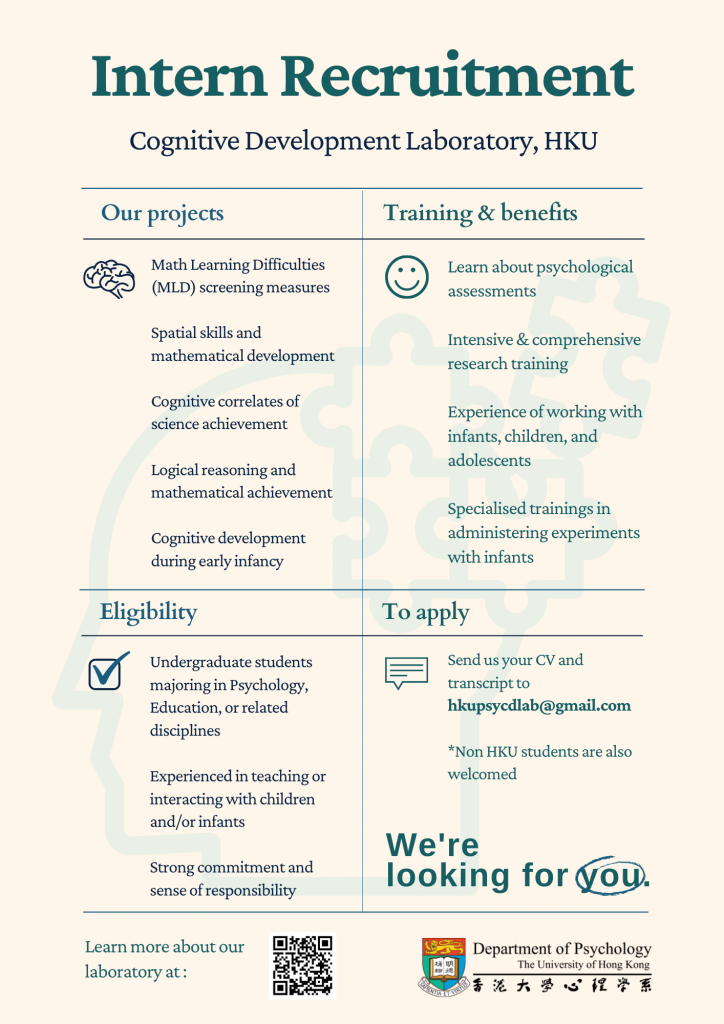
Our lab is currently working on several research projects related to the topic of mathematical cognition and science learning:
- Development of a comprehensive assessment system for identifying and supporting children with mathematics learning difficulties in Hong Kong
- Exploring the causal relation between spatial skills and math competence through a game-based spatial skills training: A randomized controlled trial
- A longitudinal investigation of the relation between logical reasoning and mathematical competence
- Relation between reasoning and math during infancy: stage 1
RESEARCH INTERNSHIP OPPORTUNITIES
 Print
Print